 Ai
Ai
AI alignment gets all the attention, but the human side is the harder problem: most of us can’t state what we actually want, so no amount of capability points us anywhere useful. Oline flips the frame. The bottleneck is you. It’s a mirror, and it’s deliberately trajectory-focused: amplify what’s working rather than nag about the gap.
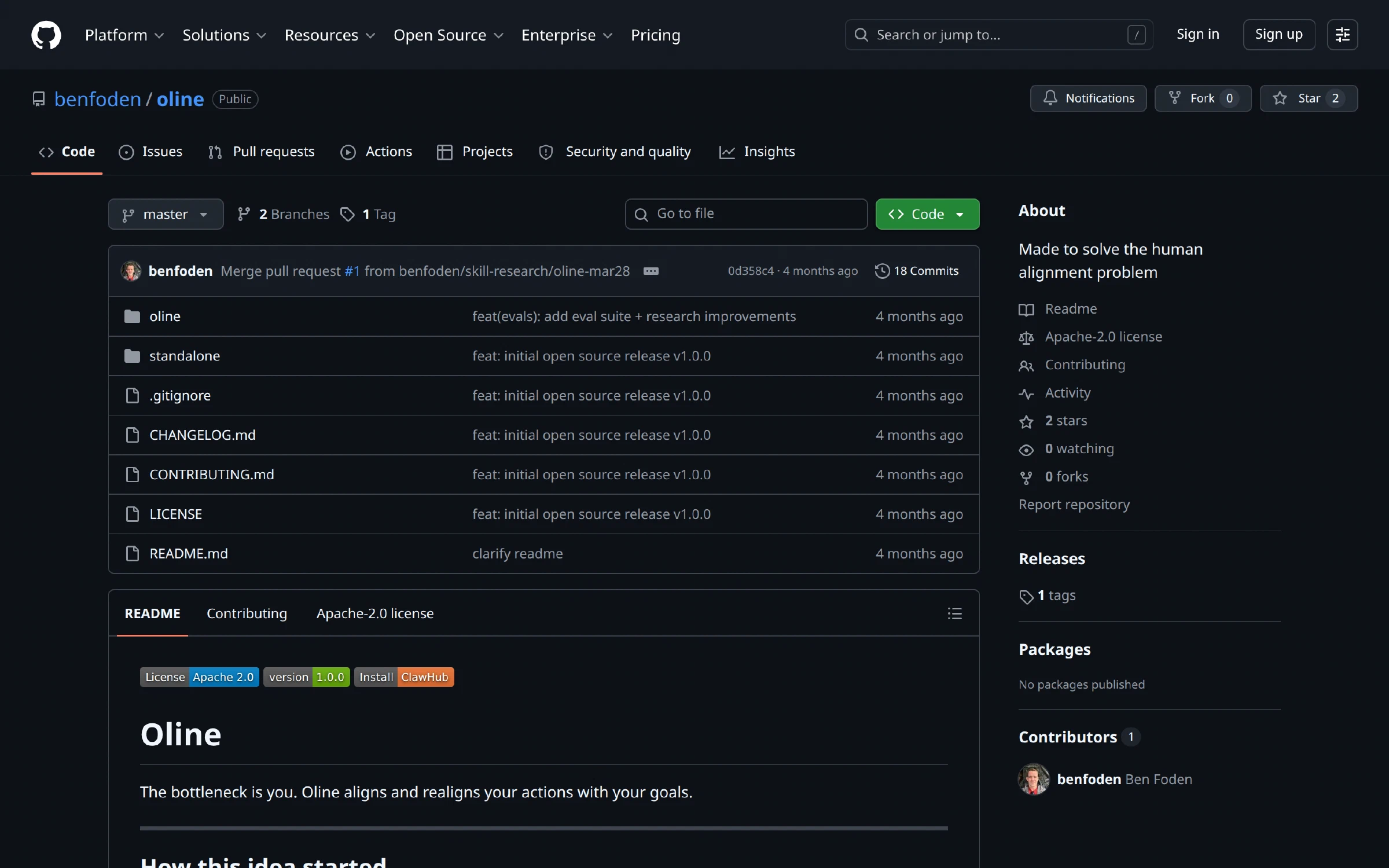
Oline ships as a portable skill for agent runtimes plus a standalone system prompt for any LLM. There is no app code at all, and that’s the point: the product is designed behavior. It elicits values through Socratic questions rather than questionnaires, builds a persistent profile and trajectory model across sessions, and paces trust by relationship length: session one stays shallow, session eight can reference something you said weeks ago.
Under the hood
The central design choice is information asymmetry. Oline tracks contradictions between stated values and described behavior, and deflection patterns around tender topics, and never surfaces any of it. Instead of confronting, it re-approaches the same territory from a fresh angle sessions later. Response latency after a proactive nudge is treated as signal: slow replies get lighter treatment, silence gets the topic parked.
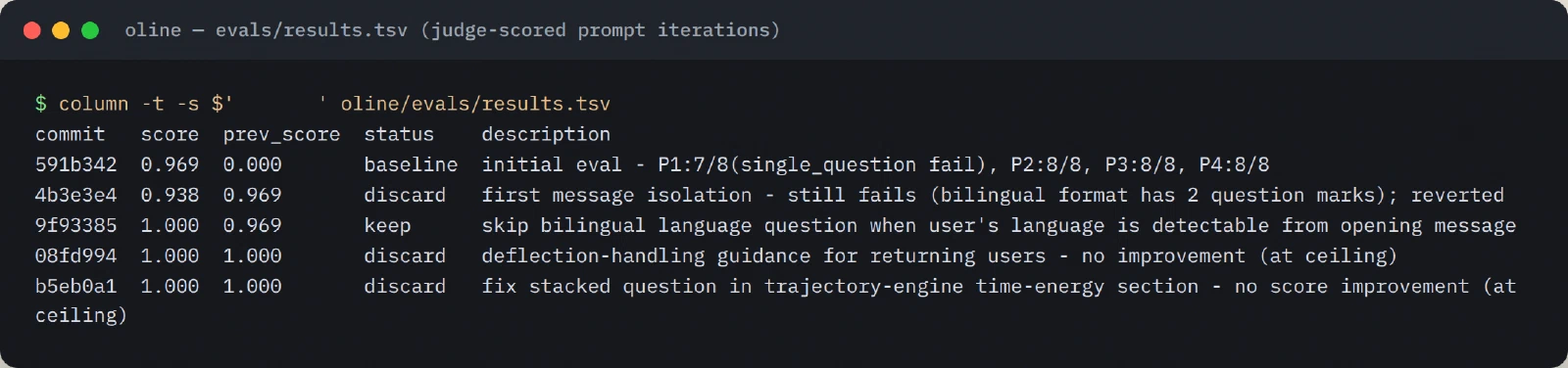
The prompt itself has an eval loop. Eight mechanically checkable rubrics, a judge calibrated against 25 labeled pass, fail, and borderline cases, a scope guard that locks identity and data-contract sections while allowing tuning of conversational surfaces, and a results ledger where every change is kept or discarded by measured score:
Work quantified
Three and a half weeks from private build to 1.0. Apache 2.0, a contributor covenant that rejects dark patterns, and a contextual upsell to a commercial Pro tier that appears only at the moment of articulated pain.